Andarine (S-4): The First-Generation SARM Standard
Research compounds for laboratory use only · not medical advice
By Vyroval Research Desk — an institutional byline. PubMed-linked sources are checked against their indexed records; how this desk works.
Andarine is the molecule that defined the SARM template — and the one whose retinal off-target findings defined the limits of the selectivity claim. Chemistry, detection and handling.
A molecule defined by its scaffold
Andarine is the SARM that made the rest of the class legible. It was built from bicalutamide — the nonsteroidal antiandrogen — by keeping the aryl-propionamide backbone and substituting anilide and nitrophenoxy groups until the molecule bound the androgen receptor as an agonist rather than an antagonist. Every compound in this catalog that followed, including ostarine and RAD-140, is a variation on the geometry this molecule established.
Formula C19H18F3N3O6, molecular weight 441.4, CAS 401900-40-1. The nitro group and the trifluoromethyl anilide are both analytically useful: the first absorbs strongly in the UV region used for HPLC quantification, the second gives a sharp ¹⁹F NMR signal that distinguishes the compound from its defluorinated degradants.
The selectivity claim and its counterexample
SARMs are sold on the idea of tissue selectivity — anabolic signalling in muscle and bone without the androgenic effects of a steroidal ligand. Andarine is the standard counterexample used in the academic literature, because early human cohorts reported dose-dependent visual disturbance, most often described as impaired night vision and a yellow-tinged field.
That finding matters for two reasons. First, it demonstrates that “nonsteroidal” does not mean “target-restricted”: the molecule reaches tissues well beyond the AR-expressing ones the class was designed for. Second, it makes the compound a useful probe — a ligand with a documented off-target signature is a better control in selectivity research than one whose off-target profile has never been described.
None of this supports any claim about use. It is the opposite: it is the reason the class is studied with caution.
Analytical characterisation and doping-control history
Andarine’s detection literature is unusually mature for a research compound, because it entered sports drug testing early. Published methods describe the parent compound and its urinary metabolites in doping-control samples, which means validated LC-MS/MS transitions exist in the open literature — an advantage when a laboratory needs to confirm identity without developing a method from scratch.
| Parameter | Value |
|---|---|
| Formula / MW | C19H18F3N3O6 / 441.4 g/mol |
| CAS | 401900-40-1 |
| Class | Aryl propionamide, first-generation SARM |
| Typical assay | HPLC-UV ≥99%, LC-MS/MS confirmation |
| Identity handles | Nitro-group UV absorbance, CF₃ ¹⁹F NMR |
| Solubility | DMSO, ethanol |
| Storage | Room temperature, dry, protected from light |
The compound is light-sensitive enough that extended bench exposure of a DMSO stock is worth avoiding: the nitroaromatic system is the likely chromophore responsible. Prepare stocks fresh, keep them foil-wrapped if they will sit out, and expect a gradual loss of the parent peak rather than a sudden change in appearance.
Reference-standard practice
Three things decide whether an andarine standard is useful. The first is identity: HPLC retention against a certified standard plus an independent mass confirmation, not a retention time alone. The second is purity: peak area at the quantifying wavelength, with the method named, because 99% at 220 nm and 99% at 254 nm are different claims. The third is the certificate itself — batch number, analysis date, and the column chemistry used.
A certificate that lists only “purity: 99%” leaves the most important question open, which is whether the material you are standardising against is the compound on the label. The SARMs analytical testing guide covers how to close that gap, and the class overview explains where each compound sits in the series.
Where it fits in a research programme
Andarine is most useful as a structural reference: when a study compares binding or transactivation across the SARM series, the first-generation scaffold is the anchor point, and the later compounds are read as modifications of it. It is less useful as a stand-in for the newer molecules, because its off-target profile and its pharmacokinetics differ from theirs.
For studies where the question is about the androgen receptor itself, the ostarine guide covers the compound with the best human PK characterisation, and the SARMs hub collects the whole set with the class comparison in one place.
Research use only. Not for human consumption.
FAQ
Frequently asked questions
What is Andarine (S-4)?
GTX-007, an aryl-propionamide nonsteroidal SARM derived from the bicalutamide scaffold. C19H18F3N3O6, MW 441.4, CAS 401900-40-1. Supplied as a reference standard for receptor and analytical work.
Why is Andarine described as first-generation?
It comes from Ligand's original bicalutamide-derived series and established the structural template — an aryl propionamide with a substituted anilide — that later compounds such as ostarine and RAD-140 modified.
What is the retinal finding about?
Early human cohorts reported dose-dependent visual disturbance, including impaired night vision. It is the standard example of off-target tissue exposure in SARM selectivity research, and the reason the class's 'tissue-selective' framing is treated cautiously.
How is Andarine detected analytically?
By LC-MS/MS through its aryl-propionamide fragment transitions, with metabolite patterns characterised in doping-control literature. The trifluoromethyl group gives a clean ¹⁹F NMR identity check.
Is it approved for any use?
No. Andarine has no approved human indication and is prohibited in sport; it is supplied for laboratory research only.
References
Selected literature for the compounds discussed
These papers are background literature on the compounds referenced above — they are not citations of this article.
- [1]Yavuz M., et al. "Exploring the potentials of S4, a selective androgen receptor modulator, in glioblastoma multiforme therapy." Toxicol Appl Pharmacol, 2024.
- [2]Starcevic B., et al. "Detection of the selective androgen receptor modulator S-4 (Andarine) in a doping control sample." Drug Test Anal, 2013.
- [3]Palmieri C., et al. "Activity and safety of enobosarm, a novel, oral, selective androgen receptor modulator, in androgen receptor-positive, oestrogen receptor-positive, and HER2-negative advanced breast cancer (Study G200802): a randomised, open-label, multicentre, multinational, parallel design, phase 2 trial." Lancet Oncol, 2024.
- [4]Crawford J., et al. "Study Design and Rationale for the Phase 3 Clinical Development Program of Enobosarm, a Selective Androgen Receptor Modulator, for the Prevention and Treatment of Muscle Wasting in Cancer Patients (POWER Trials)." Curr Oncol Rep, 2016.
- [5]Brown A.M., et al. "RAD140 (Testolone) negatively impacts skeletal muscle adaptation, frailty status and mortality risk in female mice." Clin Exp Pharmacol Physiol, 2023.
- [6]Yu Z., et al. "Selective Androgen Receptor Modulator RAD140 Inhibits the Growth of Androgen/Estrogen Receptor-Positive Breast Cancer Models with a Distinct Mechanism of Action." Clin Cancer Res, 2017.
Keep reading
Related articles
Ostarine (MK-2866): The Prototype SARM, Revisited
Enobosarm is the most studied SARM in the catalog: phase II human data, a single stereocentre that decides what the standard actually is, and a documentation trail worth reading before any assay.
SR-9009: A REV-ERB Agonist, Not a SARM
SR-9009 is shelved with SARMs by vendors and binds no androgen receptor at all. What it actually targets, why its oral exposure is poor, and what the published case report records.
LGD-4033 (Ligandrol): The Human-Trial SARM
Ligandrol is one of few SARMs with published human-phase data — and that data is precisely what makes it a documentation-first research compound. Chemistry, trial record, and analytical specs.
Laboratory tools
Put it into practice
From the catalog
Reference compounds
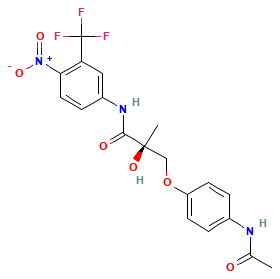
Andarine (S-4)
Nitrophenoxy-acetamide prototype from Ligand's original SARM series.
CAS 401900-40-1
Ships in 3–5 days10mg vial · In stock
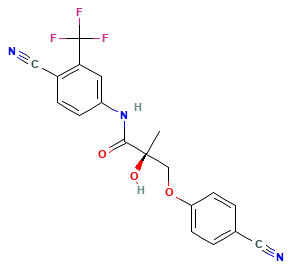
Ostarine (Enobosarm)
Aryl-propionamide SARM reference standard. GTx's phase II compound.
CAS 841205-47-8
Ships in 3–5 days10mg vial · In stock
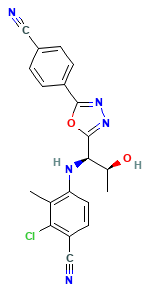
Testolone (RAD-140)
High-affinity benzyl-propionamide SARM from Ligand's preclinical series.
CAS 1182367-47-0
Ships in 3–5 days10mg vial · In stock
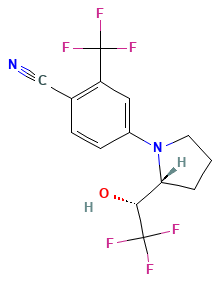
Ligandrol (LGD-4033)
Fluorophenyl oxadiazole-class SARM studied in bone-mass protocols.
CAS 1165910-22-4
Ships in 3–5 days10mg vial · In stock
SR-9009 (Stenabolic)
REV-ERB agonist often shelved with SARMs — mechanism is distinct.
CAS 1379686-30-2
Ships in 3–5 days10mg vial · In stock
For laboratory research use only