Ostarine (MK-2866): The Prototype SARM, Revisited
Research compounds for laboratory use only · not medical advice
By Vyroval Research Desk — an institutional byline. PubMed-linked sources are checked against their indexed records; how this desk works.
Enobosarm is the most studied SARM in the catalog: phase II human data, a single stereocentre that decides what the standard actually is, and a documentation trail worth reading before any assay.
What the molecule is
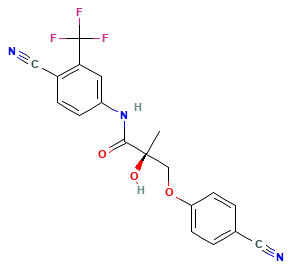
Enobosarm — GTx-024, MK-2866 — belongs to the aryl-propionamide family that produced the first clinically tested SARMs. Its structure pairs a cyanophenoxy ether with a trifluoromethyl-substituted anilide, and that combination does two things at once: it binds the androgen receptor without a steroidal scaffold, and it leaves two analytically convenient handles, a nitrile and a CF₃ group, that show up cleanly in infrared and ¹⁹F NMR respectively.
Formula C19H14F3N3O3, molecular weight 389.3, CAS 841205-47-8. The single stereocentre at the 2-hydroxy position is the part most certificates omit — see the section on enantiomers below.
The clinical record, stated plainly
Ostarine is the only compound in this catalog with published phase II human data behind it. Two programmes drove that work: healthy older adults, where the endpoints were lean body mass and physical function at 1–3 mg daily, and cancer cachexia, where the endpoint was lean mass preservation. Both produced measurable changes in the primary endpoints; neither led to approval, and the development programme did not advance past that stage.
That record is worth reading for what it constrains rather than what it promises. A compound with human pharmacokinetics is a compound whose plasma behaviour is documented — which makes it a better characterised reference material than a molecule that exists only in rodent studies. It is not evidence of safety for unsupervised use, and the trial record includes dose-dependent suppression of endogenous testosterone, which is the class effect that follows any exogenous AR ligand.
Selectivity, honestly framed
Tissue-selective signalling is the entire premise of the class, and it is also where the literature is weakest. Receptor-binding affinity can be measured; coregulator recruitment can be measured; what happens in a whole organism over months is a different question, and the human data for ostarine does not answer it. For laboratory work the useful framing is narrower: ostarine is a well-characterised AR ligand with a known human PK profile, and it makes a defensible comparator when the question is “how does this new compound behave relative to a known AR agonist”.
Compare with the preclinical series in the RAD-140 reference, the human-trial fine print in the LGD-4033 reference, and the class-level discussion in the SARMs research compounds guide. The SARMs hub collects all four.
Enantiomers: the gap in most certificates
Enobosarm’s activity sits in one enantiomer. A supplier that reports “HPLC ≥99%” without stating chiral composition is describing the sum of two species, and an AR-binding assay run against a racemate will not reproduce values from the single-enantiomer literature. When evaluating a reference standard for receptor work, ask for the chiral method explicitly: a normal-phase or chiral stationary phase run, with the enantiomeric ratio reported alongside the achiral purity.
This is not pedantry. The published pharmacology uses the resolved compound; a racemic standard is a different material with the same name.
Analytical characterisation
| Parameter | Value |
|---|---|
| Formula / MW | C19H14F3N3O3 / 389.3 g/mol |
| CAS | 841205-47-8 |
| Class | Aryl propionamide, nonsteroidal SARM |
| Typical assay | HPLC-UV ≥99%, LC-MS/MS confirmation |
| Identity handles | Nitrile IR band, CF₃ ¹⁹F NMR, [M+H]⁺ transition set |
| Solubility | DMSO, ethanol |
| Storage | Room temperature, dry, protected from light |
Mass-spectrometric detection in biological matrices relies on the nitrile-containing fragment ions, and the compound is a standard analyte in doping-control panels, which means validated methods and reference spectra exist in the public literature rather than being inferred by each laboratory.
Handling notes
Weigh into a pre-dried container: the powder is hygroscopic enough that a humid balance pan will bias a 10 mg weighing by a visible margin. Prepare DMSO stocks at a concentration that keeps the working dilution above the solubility limit of the aqueous phase — ostarine is poorly water-soluble, and precipitation at the cuvette is a common cause of “loss of activity” that has nothing to do with the compound. Avoid repeated freeze-thaw of DMSO stocks; aliquot instead.
For the wider picture on standard handling and documentation, see the quality assurance page and the SARMs analytical testing guide, which covers adulteration and assay design in detail.
Research use only. Not for human consumption.
FAQ
Frequently asked questions
What is Ostarine (MK-2866)?
Enobosarm, also coded GTx-024 or MK-2866, is an aryl-propionamide nonsteroidal selective androgen receptor modulator. C19H14F3N3O3, MW 389.3, CAS 841205-47-8. It is supplied as a reference standard for AR-binding and LC-MS/MS analytical work.
Has ostarine been in human trials?
Yes. Double-blind phase II trials evaluated 1–3 mg daily in healthy older adults and in cancer cachexia, using lean body mass and physical function as endpoints. The programme never reached approval in any market.
Why does chirality matter for a reference standard?
Enobosarm has one stereocentre, and the (S) configuration is the active ligand. A certificate that reports purity but not enantiomeric composition is describing a mixture whose receptor behaviour may differ from the single enantiomer used in the published assays.
How should ostarine be stored?
Dry, at room temperature, protected from light. Typical solubility for analytical work is DMSO or ethanol; aqueous dilution should be made fresh because the compound is poorly water-soluble.
Is ostarine a dietary supplement?
No. It has no approved human indication, is prohibited in sport under the WADA anabolic-agent class, and is supplied here strictly for laboratory research.
References
Selected literature for the compounds discussed
These papers are background literature on the compounds referenced above — they are not citations of this article.
- [1]Palmieri C., et al. "Activity and safety of enobosarm, a novel, oral, selective androgen receptor modulator, in androgen receptor-positive, oestrogen receptor-positive, and HER2-negative advanced breast cancer (Study G200802): a randomised, open-label, multicentre, multinational, parallel design, phase 2 trial." Lancet Oncol, 2024.
- [2]Crawford J., et al. "Study Design and Rationale for the Phase 3 Clinical Development Program of Enobosarm, a Selective Androgen Receptor Modulator, for the Prevention and Treatment of Muscle Wasting in Cancer Patients (POWER Trials)." Curr Oncol Rep, 2016.
- [3]Brown A.M., et al. "RAD140 (Testolone) negatively impacts skeletal muscle adaptation, frailty status and mortality risk in female mice." Clin Exp Pharmacol Physiol, 2023.
- [4]Yu Z., et al. "Selective Androgen Receptor Modulator RAD140 Inhibits the Growth of Androgen/Estrogen Receptor-Positive Breast Cancer Models with a Distinct Mechanism of Action." Clin Cancer Res, 2017.
- [5]Basaria S., et al. "The safety, pharmacokinetics, and effects of LGD-4033, a novel nonsteroidal oral, selective androgen receptor modulator, in healthy young men." J Gerontol A Biol Sci Med Sci, 2013.
- [6]Yavuz M., et al. "Exploring the potentials of S4, a selective androgen receptor modulator, in glioblastoma multiforme therapy." Toxicol Appl Pharmacol, 2024.
Keep reading
Related articles
Andarine (S-4): The First-Generation SARM Standard
Andarine is the molecule that defined the SARM template — and the one whose retinal off-target findings defined the limits of the selectivity claim. Chemistry, detection and handling.
SR-9009: A REV-ERB Agonist, Not a SARM
SR-9009 is shelved with SARMs by vendors and binds no androgen receptor at all. What it actually targets, why its oral exposure is poor, and what the published case report records.
LGD-4033 (Ligandrol): The Human-Trial SARM
Ligandrol is one of few SARMs with published human-phase data — and that data is precisely what makes it a documentation-first research compound. Chemistry, trial record, and analytical specs.
Laboratory tools
Put it into practice
From the catalog
Reference compounds
Ostarine (Enobosarm)
Aryl-propionamide SARM reference standard. GTx's phase II compound.
CAS 841205-47-8
Ships in 3–5 days10mg vial · In stock
Testolone (RAD-140)
High-affinity benzyl-propionamide SARM from Ligand's preclinical series.
CAS 1182367-47-0
Ships in 3–5 days10mg vial · In stock
Ligandrol (LGD-4033)
Fluorophenyl oxadiazole-class SARM studied in bone-mass protocols.
CAS 1165910-22-4
Ships in 3–5 days10mg vial · In stock
Andarine (S-4)
Nitrophenoxy-acetamide prototype from Ligand's original SARM series.
CAS 401900-40-1
Ships in 3–5 days10mg vial · In stock
SR-9009 (Stenabolic)
REV-ERB agonist often shelved with SARMs — mechanism is distinct.
CAS 1379686-30-2
Ships in 3–5 days10mg vial · In stock
For laboratory research use only