Retatrutide Mechanism of Action: How a Triple Agonist Works in Research
Research compounds for laboratory use only · not medical advice
GIP, GLP-1 and glucagon receptor activation — the balanced tri-agonist mechanism that makes retatrutide (LY3437943) a reference compound in metabolic research.
Retatrutide (LY3437943) is a synthetic triple-receptor agonist engineered to activate the GIP, GLP-1 and glucagon receptors with a single molecule. Where semaglutide is a selective GLP-1 agonist and tirzepatide a dual GIP/GLP-1 agonist, retatrutide adds glucagon receptor signaling to the mix — the design decision that makes it a distinct reference compound in metabolic research.
The three receptors
| Receptor | Endogenous ligand | Role in metabolic signaling |
|---|---|---|
| GIP | Glucose-dependent insulinotropic polypeptide | Incretin effect, fat-tissue signaling, insulin secretion |
| GLP-1 | Glucagon-like peptide-1 | Insulin secretion, appetite regulation, gastric emptying |
| Glucagon | Glucagon | Hepatic glucose output, energy expenditure, lipid oxidation |
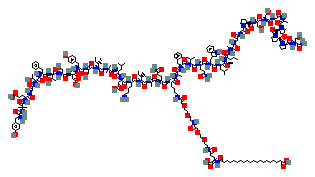
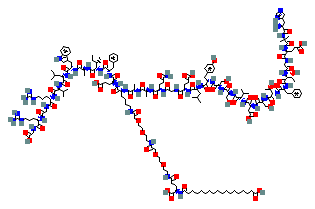
The key structural feature is a C20 fatty-diacid moiety conjugated through a linker, which extends plasma half-life via albumin binding — the same lipidization strategy used in tirzepatide.
Why the glucagon arm matters
Dual GIP/GLP-1 agonism explains appetite suppression and insulinotropic effects. The glucagon receptor component is what adds the energy expenditure dimension: glucagon signaling in liver and adipose tissue stimulates thermogenesis and lipid oxidation. In weight-loss research, this is the difference between “eat less” and “eat less and burn more.”
This makes retatrutide the reference standard for triple-agonist pharmacology — the balance of the three receptor affinities is what distinguishes it from any single- or dual-agonist compound.
Research context
Retatrutide is in late-stage clinical development (the TRIUMPH program). Published results have reported substantial weight reduction at higher doses in phase 2 data, with the effect attributed to the combination of incretin-driven appetite suppression and glucagon-driven energy expenditure. For laboratory work, it is a lyophilized research peptide supplied as a 10 mg vial — see our retatrutide research peptide page for specifications (CAS 2381089-83-2, C221H342N46O68, 99.5% purity).
Handling notes for research
- Lyophilized powder, store at -20°C
- Soluble in water and dilute acetic acid
- Reconstitute with bacteriostatic water using our reconstitution calculator — a 10 mg vial with 2 mL water gives 5 mg/mL
- Compare the triple-agonist profile with tirzepatide (dual GIP/GLP-1) and semaglutide (GLP-1 selective)
Last updated September 9, 2026
FAQ
Frequently asked questions
What makes retatrutide different from semaglutide?
Semaglutide is a selective GLP-1 receptor agonist. Retatrutide activates three receptors at once — GIP, GLP-1 and glucagon — which is why it is called a triple agonist.
Which receptors does retatrutide target?
GIP (glucose-dependent insulinotropic polypeptide), GLP-1 (glucagon-like peptide-1) and glucagon receptors, all three simultaneously.
Why does the glucagon receptor matter in metabolic research?
Glucagon receptor activation drives energy expenditure through thermogenesis and lipid oxidation — the component that separates a triple agonist from a dual GIP/GLP-1 agonist.
Is retatrutide approved for human use?
No. It is an investigational compound in clinical trials (TRIUMPH program) and supplied only as a lyophilized research peptide for laboratory use.
Keep reading
Related articles
The Peptide Cliff: Compounding Restrictions, the 503A Expansion, and What It Means for Research Supply
Why compounded semaglutide ended in 2025, what the July 2026 FDA 503A expansion changes, and how the regulatory shake-up reshapes the research peptide supply.
Retatrutide Research Findings: What the Trial Data and Preclinical Studies Show
The evidence base on retatrutide (LY3437943) — phase 2 dose-response data, the triple-agonist rationale, and what the findings mean for metabolic research.
Semaglutide Mechanism of Action: GLP-1 Receptor Agonism in Research
How semaglutide's GLP-1 receptor agonism, Aib-8 stabilization and C18 fatty-acid chain make it the reference standard for GLP-1 research.
Laboratory tools
Put it into practice
From the catalog
Reference compounds

Retatrutide
Triple-agonist (GIP/GLP-1/Glucagon). Lyophilized, mass-spec verified.
CAS 2381089-83-2
10mg vial · In stock
Tirzepatide
Dual GIP/GLP-1 agonist. Research grade.
CAS 2023788-19-2
10mg vial · In stock
Semaglutide
GLP-1 receptor agonist. Reference standard.
CAS 910463-68-2
5mg vial · In stock
HGH 191aa
Recombinant human growth hormone. Full 191aa sequence.
CAS 12629-01-5
10IU vial · In stock
For laboratory research use only