Retatrutide
Triple-agonist (GIP/GLP-1/Glucagon). Lyophilized, mass-spec verified.
Also known as: RT · RT5 · RT10 · RT15 · RT20 · RT30 · RT40 · RT50
CAS 2381089-83-2 · C221H342N46O68
Lead time
Ships in 3–5 days
Purity
99.5%
CAS Number
2381089-83-2
Molecular Weight
4757.7
Formula
C221H342N46O68
Form
Lyophilized powder
Packaging
10mg vial · 10 vials/box
Storage
-20°C, lyophilized
Solubility
Water, Acetic acid
Chemical structure
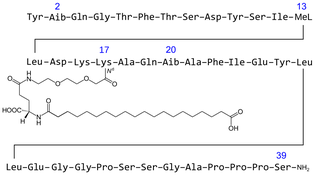
2D structure · Source: Wikimedia Commons
Research applications
Retatrutide (LY3437943) is a synthetic triple-receptor agonist engineered to activate the glucose-dependent insulinotropic polypeptide (GIP), glucagon-like peptide-1 (GLP-1), and glucagon receptors simultaneously. It is supplied as a lyophilized research peptide for in vitro and preclinical studies of energy expenditure, appetite regulation, adipose tissue metabolism, hepatic steatosis, and incretin-signaling pathways. Its balanced tri-agonist profile makes it a reference compound in metabolic research and combination-receptor pharmacology.
Reported receptor binding (EC50)
GCGR (glucagon receptor)
5.79 nM
GIPR (GIP receptor)
0.0643 nM
GLP-1R (GLP-1 receptor)
0.775 nM
Referenced literature
- [1]Rosenstock J., et al. "Retatrutide, a GIP, GLP-1 and glucagon receptor tri-agonist, for type 2 diabetes: a randomised, double-blind, placebo-controlled, phase 2 trial." The Lancet, 2023.
- [2]Jastreboff A.M., et al. "Retatrutide, a GIP, GLP-1 and glucagon receptor tri-agonist, for overweight and obesity: a randomised, double-blind, placebo-controlled, phase 2 trial." The Lancet, 2023.
- [3]Jastreboff A.M., et al. "Triple-hormone-receptor agonist retatrutide for metabolic dysfunction-associated steatotic liver disease: a randomized phase 2a trial." Nature Medicine, 2024.
Selected peer-reviewed literature for research context — not medical advice.
Quality Documentation
How we verifyRaw material screening
Off-spec lots never enter synthesis
In-process monitoring
Intermediates characterized at checkpoints
HPLC-MS verification
Identity, purity & quantitation per batch
A batch-specific COA ships with every order — see the format before you buy.
Request sample COAFrequently asked questions
What is Retatrutide?
Retatrutide (LY3437943) is a synthetic triple-receptor agonist engineered to activate the glucose-dependent insulinotropic polypeptide (GIP), glucagon-like peptide-1 (GLP-1), and glucagon receptors simultaneously. It is supplied as a lyophilized research peptide for in vitro and preclinical studies of energy expenditure, appetite regulation, adipose tissue metabolism, hepatic steatosis, and incretin-signaling pathways. Its balanced tri-agonist profile makes it a reference compound in metabolic research and combination-receptor pharmacology.
What purity is Retatrutide?
99.5% purity, HPLC-MS verified per batch.
What is the CAS number of Retatrutide?
CAS 2381089-83-2 · Molecular formula C221H342N46O68 · Molecular weight 4757.7.
How long does Retatrutide take to ship?
Ships in 3–5 days after order confirmation.
How should Retatrutide be stored?
-20°C, lyophilized. Solubility: Water, Acetic acid.
Is Retatrutide for human use?
No. Retatrutide is a research compound for laboratory research use only — not for human or veterinary use.
For pricing and availability of Retatrutide, contact our research team.
For laboratory research use only.
Related compounds
Related journal
The Peptide Cliff: Compounding Restrictions, the 503A Expansion, and What It Means for Research Supply
Why compounded semaglutide ended in 2025, what the July 2026 FDA 503A expansion changes, and how the regulatory shake-up reshapes the research peptide supply.
Retatrutide Dosage and Reconstitution Math: 10 mg Vial in the Lab
Retatrutide (RT) vial math — reconstituting a 10 mg lyophilized vial, converting mg to mL and U-100 units, and the common research dose ranges.
Retatrutide Mechanism of Action: How a Triple Agonist Works in Research
GIP, GLP-1 and glucagon receptor activation — the balanced tri-agonist mechanism that makes retatrutide (LY3437943) a reference compound in metabolic research.