GLOW & KLOW Blends: What's Inside the Four-Peptide Combos
Research compounds for laboratory use only · not medical advice
GLOW (BPC-157 + GHK-Cu + TB-500) and KLOW (GLOW + KPV) — what each blend actually contains, why pre-blending at fixed ratios, and the reconstitution math per component.
The GLOW and KLOW blends are the two most-asked-about pre-mixed research combinations in the catalog. They get lumped together, and the names don’t tell you the contents — this guide lists exactly what is in each vial and how the math works when you reconstitute.
What each blend contains
| Blend | Vial total | Components |
|---|---|---|
| GLOW | 70 mg | BPC-157 10mg · GHK-Cu 50mg · TB-500 10mg |
| KLOW | 80 mg | BPC-157 10mg · GHK-Cu 50mg · TB-500 10mg · KPV 10mg |
Both share the same three-component base — BPC-157, GHK-Cu and TB-500 — which is why they read as a family. KLOW extends the formulation with KPV, a three-amino-acid fragment of alpha-MSH studied for inflammatory pathway modulation.
Why pre-blend at fixed ratios
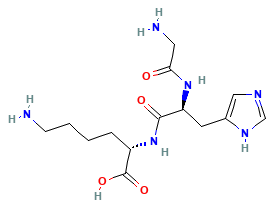
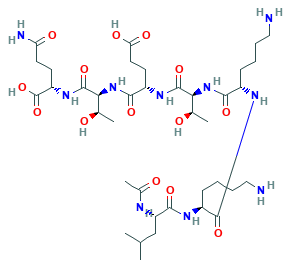
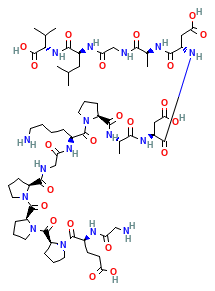
Each component has a separate research footprint: BPC-157 in angiogenesis and gastrointestinal mucosa models, TB-500 in cell-migration work around the actin-binding domain, GHK-Cu in copper-dependent collagen and tissue-remodeling studies, and KPV in anti-inflammatory signaling. Combined protocols reference these together at particular ratios — the blend fixes that ratio in a single vial so one reconstitution delivers all four at their documented masses. That removes a set of pipetting steps and keeps the ratio stable across a protocol, at the cost of not being able to titrate one component independently.
Reconstitution math
The total lyophilized mass is the sum of the components — 70mg for GLOW, 80mg for KLOW. Reconstitution follows the same rule as any peptide vial: add bacteriostatic water, divide the total by the volume for the overall concentration, and each component keeps its per-vial mass.
For GLOW at 2 mL: total concentration is 35 mg/mL, and the individual concentrations are BPC-157 5 mg/mL, GHK-Cu 25 mg/mL, TB-500 5 mg/mL. The reconstitution calculator handles the per-component math directly.
Research context
The blend concept comes from combined-protocol literature: BPC-157 and TB-500 appear together in soft-tissue repair work, and GLOW/KLOW layer in the copper peptide and the anti-inflammatory tripeptide. None of the combined formulations has phase-1 human data — the rationale is component-level, which is standard for this class of research materials.
For researchers who need independent titration, the single-compound vials remain available; the blends exist for fixed-ratio protocols.
Last updated September 9, 2026
FAQ
Frequently asked questions
What is the difference between GLOW and KLOW?
KLOW is GLOW plus KPV. GLOW contains BPC-157 10mg, GHK-Cu 50mg and TB-500 10mg (70mg total). KLOW adds KPV 10mg on top of the same three (80mg total), for an additional anti-inflammatory tripeptide arm.
How do I reconstitute a 70mg GLOW vial?
The total is 70mg of lyophilized peptide. Add 2mL of bacteriostatic water for 35mg/mL total; each component keeps its documented mg per vial (BPC-157 10mg, GHK-Cu 50mg, TB-500 10mg) so per-component dosing follows the standard vial math.
Why buy a pre-mixed blend instead of separate vials?
The blend fixes the ratio in one vial — one reconstitution gives all components at the documented masses, removing pipetting steps and ratio drift. You can also use the single-compound vials if a protocol needs independent titration.
Keep reading
Related articles
BPC-157 Dosage and Reconstitution Math: 5 mg Vial in the Lab
BPC-157 vial math — reconstituting a 5 mg lyophilized vial, mg to mL and U-100 unit conversions, and common research dose ranges.
GHK-Cu Reconstitution and Vial Math: 50 mg Copper Peptide in the Lab
GHK-Cu (CU50) vial math — reconstituting a 50 mg copper tripeptide vial, mg to mL conversions, and the concentrations used in cell-culture work.
KPV Peptide: The Anti-Inflammatory α-MSH Fragment
KPV (Lys-Pro-Val), the C-terminal tripeptide of α-MSH, and its research profile in cytokine modulation, NF-κB signaling and mucosal integrity studies.
Laboratory tools
Put it into practice
From the catalog
Reference compounds
GHK-Cu
Copper tripeptide-1. Tissue regeneration studies.
CAS 49557-75-7
50mg vial · In stock
TB-500
Thymosin β4 fragment. Actin-binding domain active.
CAS 885340-08-9
5mg vial · In stock
BPC-157
Pentadecapeptide. Gastric pentadecapeptide research.
CAS 137525-51-0
5mg vial · In stock

Bacteriostatic Water
0.9% benzyl alcohol, sterile USP-grade solvent.
CAS 7732-18-5
10mL vial · In stock
For laboratory research use only