Testosterone Cypionate: The US Depot Standard, Examined
Research compounds for laboratory use only · not medical advice
What testosterone cypionate is, why its ~8-day kinetics made it the pharmacy standard in the United States, and how it differs from enanthate beyond the ester.
Two esters dominate injectable testosterone history: enanthate in Europe, cypionate in the United States. Same hormone, slightly different clock.
The molecule
Testosterone cypionate (C₂₇H₄₀O₃, ≈412.6 g/mol) is unmodified testosterone behind a cyclic ester — fully aromatizable, fully 5α-reducible, exactly the molecule the body makes, just released over days instead of hours. In the ester master reference it sits at ≈8 days half-life, between enanthate and the two-week undecylenate/decanoate tier; the clearance calculator and half-life plotter turn any starting point into a decay curve.
The enanthate-versus-cypionate question is answered in depth in our comparison article; the short version is that meta-analytic PK work finds small, not zero, differences in time-to-steady-state and peak flatness.
Research context
Cypionate is the reference testosterone in much of the older depot-endocrinology literature — the 1950s–80s testosterone-replacement trials that shaped dosing schedules used it, so reproducing or citing those curves requires the same ester. It is also the baseline arm in aromatase, 5α-reduction and SHBG-binding models where “plain testosterone kinetics over a week” is the control condition.
Practical notes
200 mg/mL oil solution, 10 mL vials — no reconstitution. CAS and documentation on Testosterone Cypionate; the four-ester hybrid lives in Sustanon 250.
References: Kicman A.T., “Pharmacology of Anabolic-Androgenic Steroids.” Handbook of Experimental Pharmacology, 2008 · Schulz & Nygaard, long-acting testosterone preparations, Acta Pharmacol Toxicol, 1980s depot comparisons.
For laboratory research use only. Not medical advice.
FAQ
Frequently asked questions
What is testosterone cypionate?
Testosterone cypionate is testosterone esterified with cyclopentanepropionate — the depot form that became the standard prescription testosterone in the United States from the 1950s onward.
How long is its half-life?
About 8 days in our ester table (active fraction ≈70%), slightly longer than enanthate's ≈5 days — one reason weekly or biweekly intervals were historically studied with it.
Is cypionate different from enanthate clinically?
The parent hormone is identical; the ester changes solubility and release rate slightly. Head-to-head pharmacokinetic studies show modest differences — our comparison article summarizes them.
Why is it called 'cyp'?
Short for cyclopentylpropionate — the ester's ring structure. The 'test' part is plain testosterone; no 17α-alkylation, no DHT restriction, fully aromatizable.
Keep reading
Related articles
Anavar (Oxandrolone): The Mild-Profile Oral
Oxandrolone's high anabolic-to-androgenic ratio, its ~9–12 hour half-life, and the 10 mg tablet math for research protocols.
Ester Half-Lives and Clearance: What Every Researcher Should Know
What an ester is, why half-life drives injection frequency, how first-order clearance works, and when a compound is effectively cleared.
All 11 Esters at a Glance: The Master Reference Table
Half-life, active fraction and clearance math for every ester in the Vyroval catalog — one table to bookmark, with links to the tools that model each one.
Laboratory tools
Put it into practice
From the catalog
Reference compounds
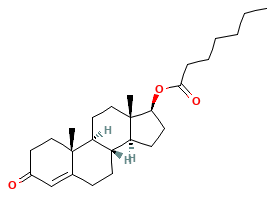
Testosterone Enanthate
Long-ester testosterone. 250mg/mL in USP-grade carrier oil.
CAS 315-37-7
10mL vial · In stock
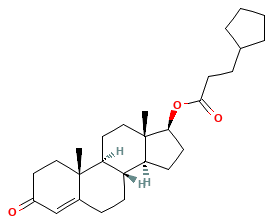
Testosterone Cypionate
Cyclopentyl ester testosterone. Extended half-life profile.
CAS 58-20-8
10mL vial · In stock
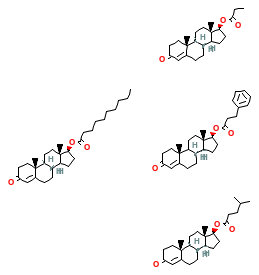
Sustanon 250
Four-ester testosterone blend. Extended release profile.
CAS 68924-89-0
10mL vial · In stock
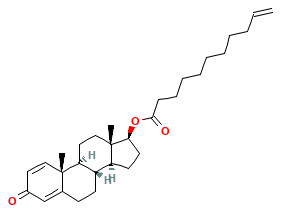
Boldenone Undecylenate
Undecylenate ester. Sustained-release anabolic standard.
CAS 13103-34-9
10mL vial · In stock
For laboratory research use only