Time until a compound is cleared
Laboratory Tools
Ester Clearance Calculator
Reference decay math from literature ester half-lives — remaining fraction after any interval and time to 5% or 1% of the starting amount.
Half-life in, clearance out.
Long-acting esters release hormone slowly and take weeks to clear. See how much of a compound remains at any point after the last dose, and when it falls to 5% or 1% — the standard research thresholds for "effectively cleared".
Est. half-life
— days
Remaining now
—
Time to 5% remaining
—
Time to 1% remaining
—
Reference decay curve (12-week window)
Clearance reference — time to 5% remaining
| Compound | Est. half-life | ≈ 5% clearance |
|---|---|---|
| Testosterone Enanthate | 4.5 days | ≈ 2.8 weeks |
| Testosterone Cypionate | 8 days | ≈ 4.9 weeks |
| Sustanon 250 (blend) | 8 days | ≈ 4.9 weeks |
| Trenbolone Acetate | 2 days | ≈ 1.2 weeks |
| Nandrolone Decanoate | 15 days | ≈ 9.3 weeks |
| Boldenone Undecylenate | 14 days | ≈ 8.6 weeks |
| Drostanolone Propionate | 4.5 days | ≈ 2.8 weeks |
| Methenolone Enanthate | 10 days | ≈ 6.2 weeks |
| Stanozolol (oral) | 0.5 days | ≈ 0.3 weeks |
| Oxandrolone (oral) | 0.5 days | ≈ 0.3 weeks |
| Methandrostenolone (oral) | 0.5 days | ≈ 0.3 weeks |
Share this calculation
How it works
The math
Exponential decay
remaining = 100 × e^(−k·t), k = ln2 ÷ half-life
Each half-life halves the remaining amount: 1 → 50% → 25% → 12.5% → 6.25% → 3.1%. After five half-lives roughly 3% remains — the conventional "cleared" threshold in research protocols.
Example — nandrolone decanoate
With a ~15 day half-life, reaching 5% remaining takes ≈ 4.3 × 15 = 65 days (≈ 9.2 weeks). An acetate with a 2-day half-life clears to 5% in under 9 days. This is why ester choice dominates cycle timing.
Simplified single-compartment model with population-average half-life estimates. For laboratory research context only — not medical advice and not a drug-testing prediction.
FAQ
Frequently asked questions
What does 'time to 5% remaining' mean?
Under a first-order clearance model, the active amount of a compound decays by a fixed fraction per half-life. Five percent remaining corresponds to about 4.3 half-lives; one percent to about 6.6 half-lives.
Why are these estimates, not exact times?
Half-lives are population averages from published pharmacokinetic studies and vary substantially between individuals (metabolism, dose history, ester release kinetics). The model is for laboratory research context only.
Does this predict drug-test detection windows?
No. Detection windows depend on metabolites, testing method and cut-off thresholds — not just the parent compound's half-life. This tool models clearance math only.
How is the clearance curve drawn?
Remaining percent = 100 × e^(−k·t) with k = ln2 ÷ half-life. After one half-life 50% remains, after two 25%, and so on.
From the catalog
Related compounds
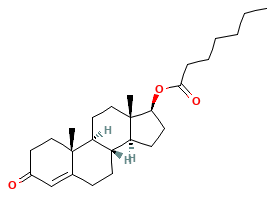
Testosterone Enanthate
Long-ester testosterone. 250mg/mL in USP-grade carrier oil.
CAS 315-37-7
10mL vial · In stock
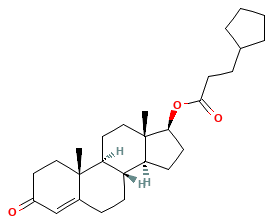
Testosterone Cypionate
Cyclopentyl ester testosterone. Extended half-life profile.
CAS 58-20-8
10mL vial · In stock
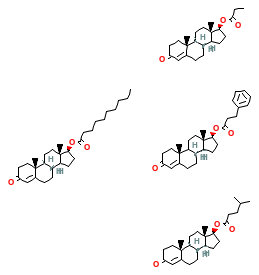
Sustanon 250
Four-ester testosterone blend. Extended release profile.
CAS 68924-89-0
10mL vial · In stock
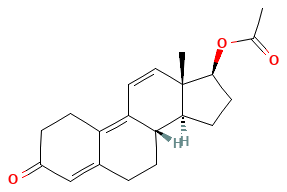
Trenbolone Acetate
19-nor anabolic compound. High receptor binding affinity.
CAS 10161-34-9
10mL vial · In stock
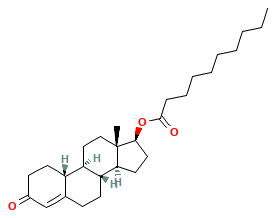
Nandrolone Decanoate
19-nor decanoate ester. Long-acting reference compound.
CAS 360-70-3
10mL vial · In stock
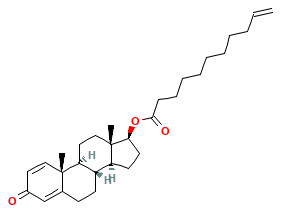
Boldenone Undecylenate
Undecylenate ester. Sustained-release anabolic standard.
CAS 13103-34-9
10mL vial · In stock
For laboratory research use only